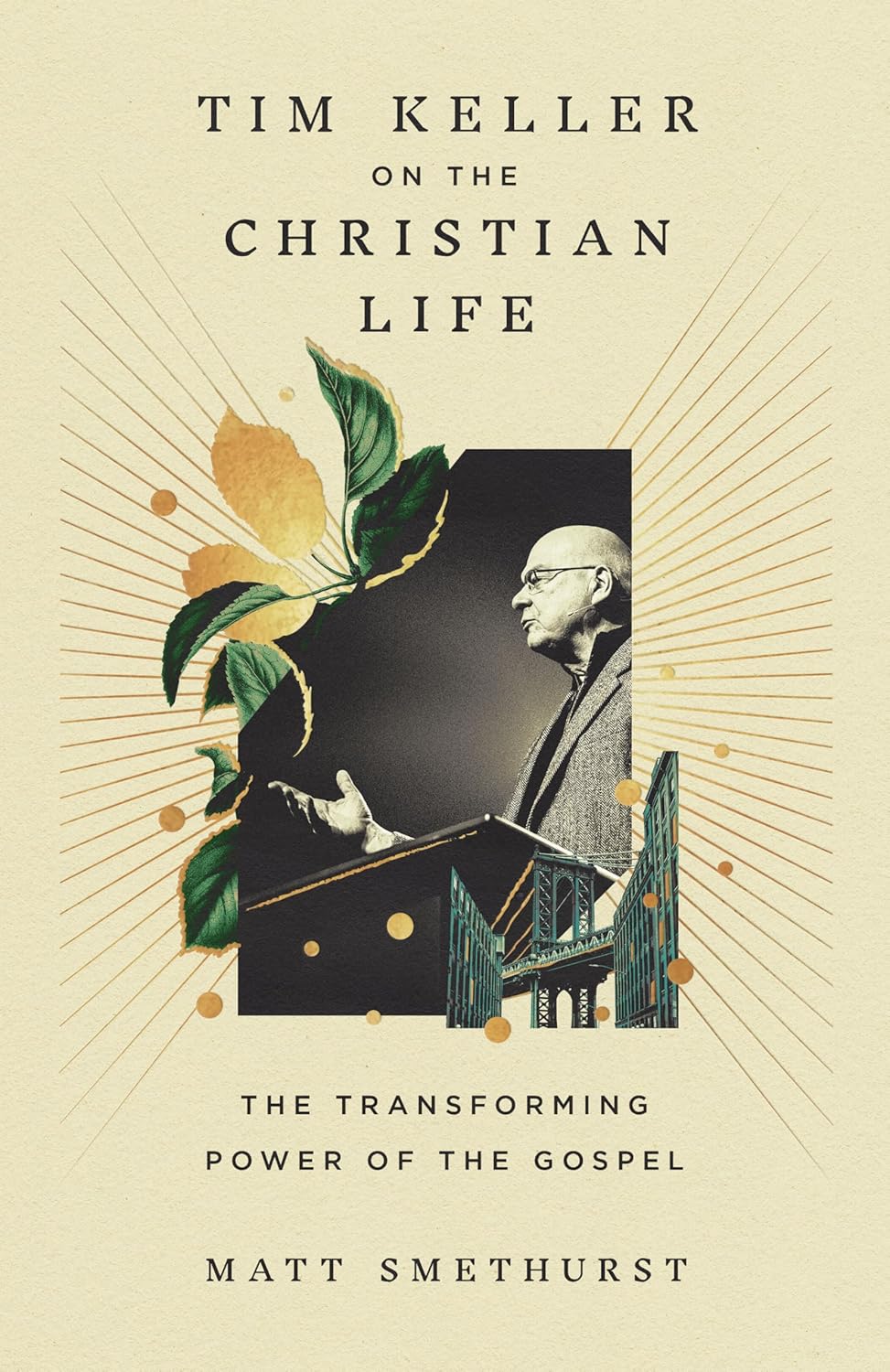
Lately I’ve really enjoyed reading everything I can find about Tim Keller. I’ve read all of his books over the years and listened to many of his sermons. I’ve relistened to many since his passing and just enjoy learning more about how he came to Christ and how he learned to serve people in different contexts without ever forsaking the truth of the gospel. Matt Smethurst’s latest work Tim Keller on The Christian Life: The Transforming Power of the Gospel is a great and helpful read. I’d highly commend it to both the Christ follower and the skeptic.
I highlighted several things while reading and have posted those notes below…
- Keller observed that, generally speaking, in a small town “your pastoring sets up your preaching.” That is, people won’t respect you as a preacher unless they trust you as their pastor. But in a big city it’s often the opposite: “Your preaching sets up your pastoring.” People won’t trust you as their pastor unless they respect you as a preacher. Keller experienced both dynamics, but his renowned preaching was infused with wisdom gleaned from years of diligent pastoring. Location 134
- Though my purpose is to distill Keller’s best teaching on the Christian life, rather than evaluate his legacy, I will take the liberty to point out that he was a three-dimensional voice in a two-dimensional world. To borrow philosophical categories, Keller combined the normative (keen biblical insight) with the situational (studied awareness of the cultural moment) with the existential (searching heart application). Think Bible teacher meets cultural analyst meets biblical counselor. Most great pastors tend to do two of these well, but Keller excelled at all three. The first and third are where he is probably least appreciated. Some may hear Keller quoting philosophers and New York Times columnists and assume his preaching was super scholarly or fancy. But it really wasn’t. His illustrations were vivid, and his applications penetrating—precisely because they were down-to-earth. Location 228
- Running through Keller’s enormous body of work is a single thread that connects the diverse dots into a coherent whole. Above all, he was enamored with one great reality—the person and work of Jesus Christ—and he spent his life showcasing this treasure. Location 259
- If we ever hope to properly handle the stories in the Bible, we must first grasp the story of the Bible. And that story—one that traverses its way from Genesis to Revelation—though recorded for you, is not ultimately about you. The central focus is higher, and the central figure is better. Given the Bible’s breathtaking diversity, the plotline’s essential coherence is astonishing: sixty-six books of various genres over forty authors from various backgrounds and occupations over fifteen centuries ten civilizations three continents three languages one unified story of redemption. Remarkably, the Bible has one ultimate plan, one ultimate plot, one ultimate champion, one ultimate hero. And from the beginning we can see his silhouette. Location 274
- A sweeping, aerial view of the Bible’s topography, focused on Christ, would therefore look something like this: Old Testament: anticipation, Gospels: manifestation, Acts: proclamation, Epistles: explanation, Revelation: consummation Location 302
- Consider, for example, how Keller explains his typical sermon structure (again, this is relevant not just to those who deliver sermons but to all who listen to them): Intro: What the problem is; our contemporary cultural context: Here’s what we face. Early points: What the Bible says; the original readers’ cultural context: Here’s what we must do. Middle points: What prevents us; current listeners’ inward heart context: Why we can’t do it. Late points: How Jesus fulfills the biblical theme and solves the heart issue: How Jesus did it. Application: How through faith in Jesus you should live now. Location 274
- As a case study, he offers the example of Abraham and Isaac in Genesis 22: 1. What we must do: Put God first in every area of life, as Abraham did. (This is unfortunately where many sermons end!) 2. But we can’t: We can’t! We won’t! So we deserve to be condemned. 3. But there was one who did: On the cross, Jesus put God first. His was the ultimate and perfect act of submission to God. Jesus is the only one to whom God ever said, “Obey me, and as a result I will judge you and condemn you.” Jesus obeyed anyway—just for truth’s sake, for God’s sake. The only perfect act of submission. 4. Only now can we change: Only when we see that Jesus obeyed as Abraham did—for us!—can we begin to live like Abraham. Let your heart be shaped by this. Location 384
- Again, we can be so quick to “get to the gospel” in our Bible reading that we run roughshod over the text at hand. That’s a legitimate danger. Thankfully, though, the instinct for detecting Christ responsibly can be honed. In fact, the experience is a bit like watching the Bruce Willis film The Sixth Sense—for the second time. Keller explains, That movie has a startling ending that forces you to go back and reinterpret everything you saw before. The second time through, you can’t not think of the ending as you watch the beginning and middle of the movie. The ending sheds unignorable light on everything that went before. In the same way, once you know how all the lines of all the stories and all the climaxes of all the themes converge on Christ, you simply can’t not see that every text is ultimately about Jesus. Location 436
- When Redeemer was less than two years old, Keller pressed home that robust theology, once internalized, makes all the practical difference in the world: You, my dear friends, have to realize there is no way you will ever have a loving, Christian lifestyle unless you’re continually coming back to this doctrine. To the degree that you have grasped the doctrine of the substitutionary, vicarious death of Jesus Christ on the cross, you will walk in love. If you don’t walk in love, you haven’t grasped the doctrine. Location 530
- The biblical picture of Christian friendship is remarkable, Keller says. It is “not simply about going to concerts together or enjoying the same sporting event. It is the deep oneness that develops as two people journey together toward the same destination, helping one another through the dangers and challenges along the way.” Location 1402
- Later he realized God was saying, “Son, when a child of mine makes a request, I always give that person what he or she would have asked for if they knew everything I know.” Location 2405
Categories: