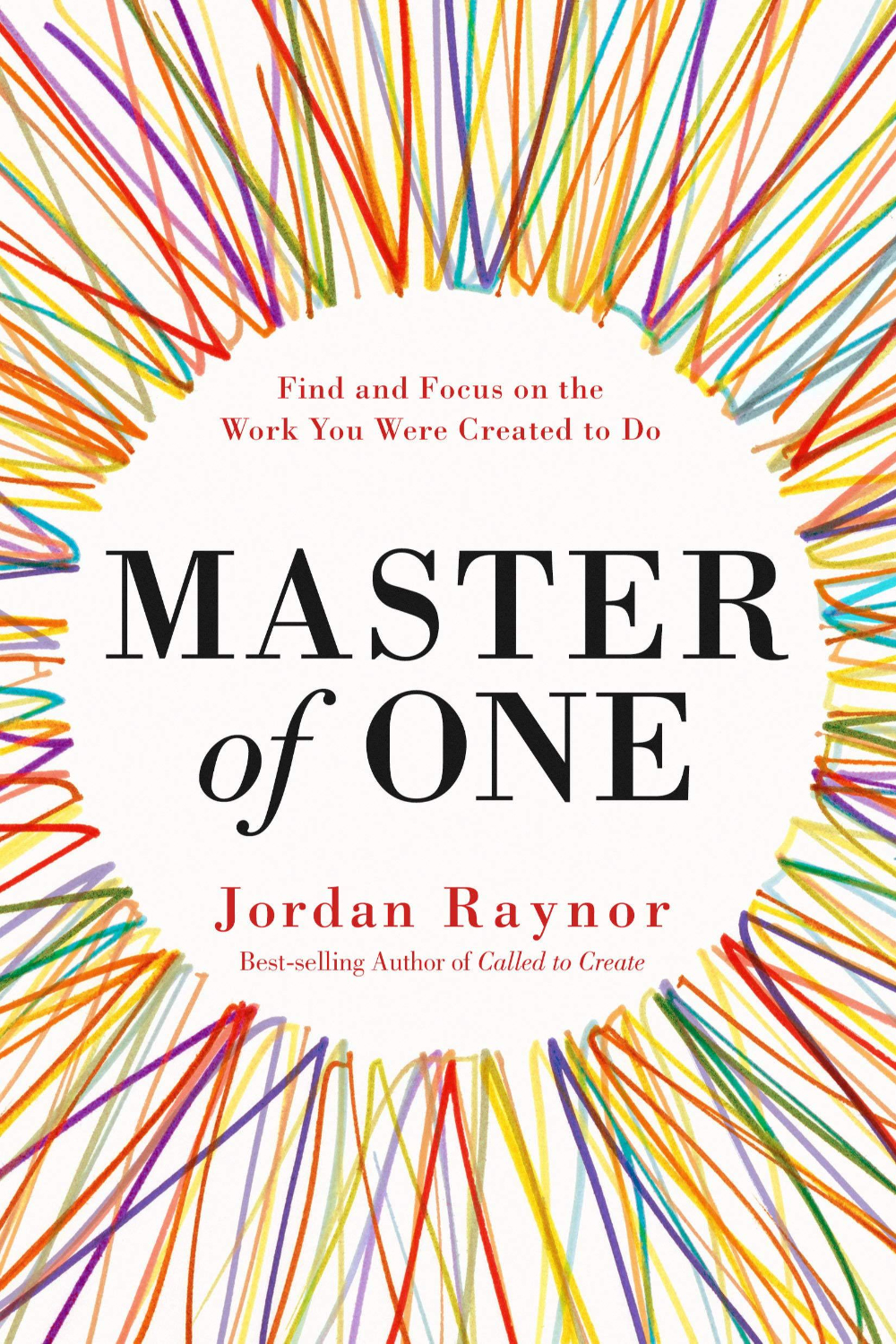
I have really enjoyed Jordan Raynor’s writing as it helps the reader focus on God’s calling rather than all the other things clamoring for our attention. The Sacredness of Secular Work, Called to Create, and Redeeming Your Time are some of my other favorites. Master of One specifically is focused on helping a person understand their calling and the sacrifices that you have to make to stay laser-focusedon what God has put you on this earth to do.
I highlighted several things while reading and have posted those notes below…
- We are overcommitted, overwhelmed, and overstressed, spending way too much time focused on minutiae rather than the work we believe God created us to do. pg. xiii
- When we are stretched as thin as most of us are today, we are all but guaranteed to do everything with mediocrity rather than mastery. As Köstenberger pointed out, “This mediocrity has in many cases become a curse—a curse that has kept us from reaching our personal, creative, and [professional] potential given to us by God, and has prevented us from impacting other believers as well as unbelievers for the glory of God and for his kingdom.” p. xiv
- The path to doing our best work for God’s glory and the good of others is the path of “less but better.” of continually pruning our careers in order to focus on the work we were created to do most exceptionally well for the glory of God and the good of others. p. xvi
- Explore, Choose, Eliminate, and Master. In this part of the book, we will answer questions such as: What is the quickest path to experimenting with and choosing your one vocational thing? How do you know when you’ve found your one thing or, in other words, your calling? Is a calling something you choose or something that chooses you? Once you’ve said yes to your one thing, how do you practically say no to everything else? How do you get masterful at something if you can’t find the right mentor? What are the keys to mastery that separate masters from their less masterful counterparts? p. xix
- You achieve true mastery when you identify the few things God has created you to do most exceptionally well and work at them “with all your heart, as working for the Lord” (Colossians 3: 23). p. xxi
- “Excellence is doing something at the very highest level it can be done using all your capabilities and everything God has given you,” Dungy said. p. 5
- It is precisely because we are called to be excellent in all things that we can’t commit to being excellent at many things. p. 7
- When we say yes to everything, we say yes to nothing, including the unique work the Father has put us on this earth to do. p. 16
- As Christians we are called to pursue excellence in all things as a means of reflecting the character of our exceptional God. This truth, coupled with the laws of time and trade-offs, means that we simply cannot pursue mastery at many things professionally at the same time. It is precisely because we are called to be excellent in all things that we can’t commit to being excellent at many things vocationally. p. 20
- As God’s children we are called to be his image bearers, reflecting his character of excellence in every aspect of life, including our work. Thus, one of the most fundamental purposes of pursuing mastery in our work is the pursuit of God’s glory. We glorify him and proclaim his excellencies when we do our work masterfully well. p. 37
- Pastor Timothy Keller said, “One of the main ways that you love others in your work is through the ‘ministry of competence.’ If God’s purpose for your job is that you serve the human community, then the way to serve God best is to do the job as well as it can be done.” p. 45
- If the first, most fundamental purpose of masterful work is to bring God glory, the second is to love our neighbors as ourselves. We ought to pursue excellence in our work not as a means to an end but in obedience to what Jesus identified as the Greatest Commandments. As Christians we can’t claim to love our neighbor as ourselves and then do our work with mediocrity. Mediocre work is nothing short of a failure of love. It is through the ministry of excellence that we love our neighbors through our work. p. 52
- These are the best questions to ask in the process of choosing your one vocational thing: What am I passionate about? What gifts has God given me? Where do I have the best opportunity to glorify God and serve others? p. 63
- In chapter 5 (“Explore”), we will start down the path to mastery by forming hypotheses about what we think our one thing might be and putting those hypotheses to the test in a process of rapid experimentation. The goal in this first step is—to extend the metaphor of the sower—to gather and scatter seeds widely in an attempt to see what will start to grow. In chapter 6 (“Choose”), we will examine the fruits of our experimentation and make the difficult decision to “pivot” our careers or “persevere,” choosing to commit to developing the one plot of land that is starting to produce the fruits of divine multiplication. In chapter 7 (“Eliminate”), we will examine why, once you’ve chosen your one thing, it is essential to eliminate the nonessential, refusing to plant more seeds in the rocky and thorny soil. Finally, in chapter 8 (“Master”), we will examine the difference between those who are merely good at their jobs and those who are masters of their crafts, deliberately developing the soil in which their one thing is planted through apprenticeships, purposeful practice, and discipline over time. p. 75
- On the path to mastery, we are forced to make many left/right decisions—decisions to pivot persevere in pursuit of the path that best combines our passions and gifts to glorify God and serve others through our work. p. 104
- If we are going to do our most exceptional work for God’s glory and the good of others, we are going to need to commit to “staying in love” with one thing vocationally and put in the disciplined effort it takes to become masterful at the work the Father has given us to do. We are going to need a tremendous amount of passion, discipline, and grit. p. 152
- When we do our work exceptionally well—focusing first and foremost on serving others rather than pushing a particular agenda—we win the respect of the world and earn the right for our message to be heard. p. 164
- When we focus on getting masterfully good at our one thing, we win the respect of the world. We become the salt of the earth that makes others thirsty to be around us and long to understand what makes us tick. And this gives us unparalleled opportunities to shine the light of Christ to the world. p. 167
- It is only when we get insanely good at what we do that we don’t just fall in love with our work but stay in love with it over a long period of time. p. 192
- Let us not be content with the shallow happiness that is so easily attained through mediocrity. Instead, let us passionately and unashamedly chase the infinite joy that comes with mastering the work we were created to do, thereby sharing the Master’s happiness and feeling his pleasure. p. 195
Categories: