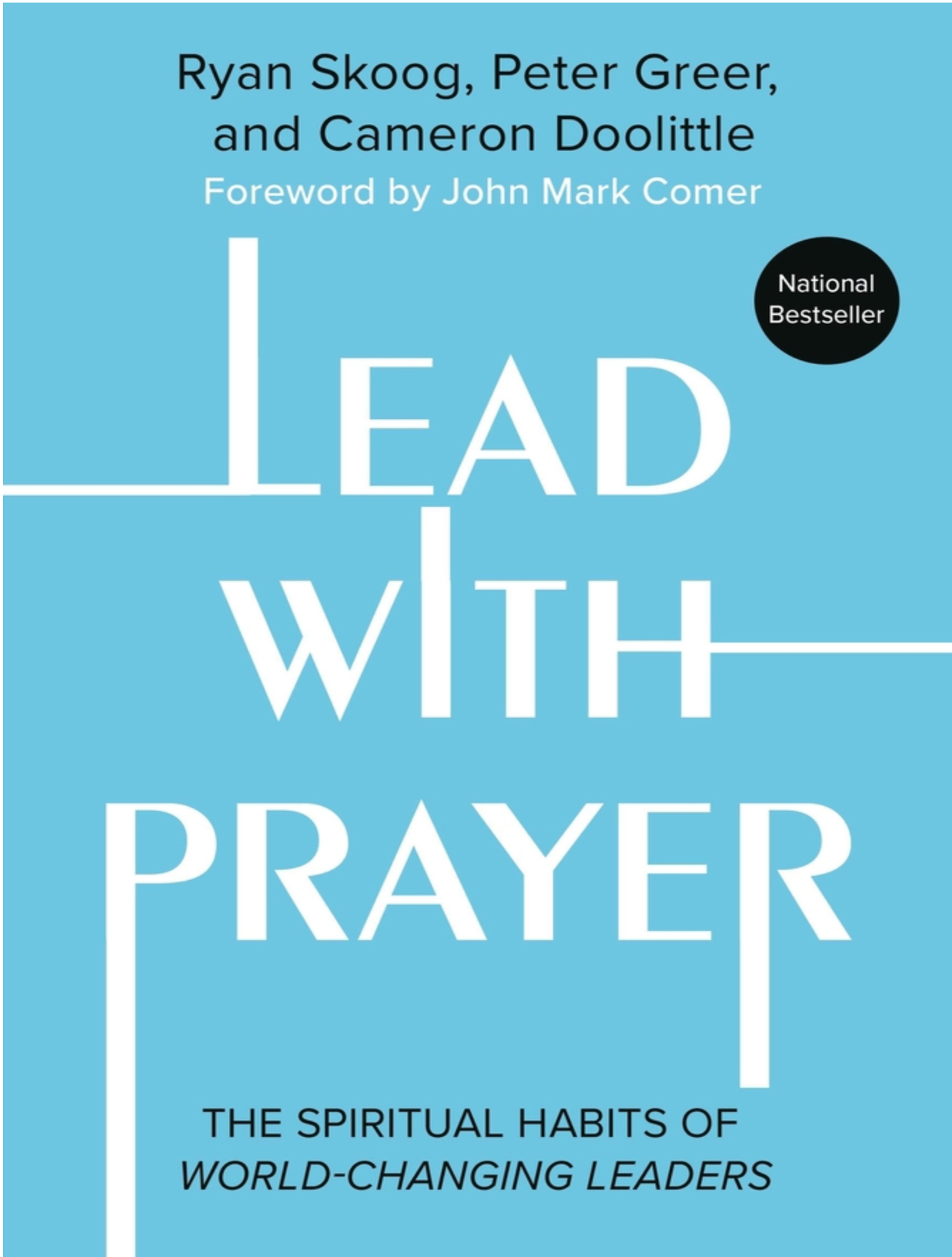
I’ve enjoyed reading Peter Greer’s work in a variety of formats lately. He spoke at the CESA Symposium in early October and we were gifted a copy of Lead with Prayer: The Spiritual Habits of World-Changing Leaders. What’s funny is that the original plan was for us to be gifted another of his books and these were sent by mistake. I’m so grateful it was! This semester at school we have been studying prayer and what it looks like to align our hearts with the heart of God. We have been in a series and season at church on prayer. It’s almost as if the Lord is sending me a message of some sort!
This book was a great read and powerful reminder of this truth:
“It’s hard to be arrogant on our knees, where our hearts are reminded that we are first followers, not leaders.” So many leaders today have let other things take the place of first things and that’s one of the main reasons our culture has become what it has. Ever since Genesis 3, we’ve been pursuing our own way and it continues to lead us into a ditch.
The greatest value of this book is the Scripture throughout that challenges us to ABIDE. This book would be a great one for a Bible study group or a discipleship type of relationship. I highlighted several things while reading and have posted those notes below.
- Personally and anecdotally we know that Christian leaders often lead out of our own strength, dedicating significant time to research, strategy, and discussion before rounding out our efforts with a quick prayer for God to bless our plans. p. xvi.
- When leadership scholar J. Robert Clinton studied biblical leaders, he found that only 30 percent “finished well.” He believes even fewer are finishing well today, and the connection to prayer is causal and clear: “In latter ministry, the tendency is to rely on complacency, one’s ability to do things, rather than primarily on God.” p. xvii
- An intentional prayer life is the nonnegotiable constant of lasting, fruitful Christian life and leadership. p. xxi
- C.S. Lewis’s spiritual mentor, Father Walter Adams, instilled in Lewis on simple, life-altering concept: “Look after the roots, and the fruits will look after themselves.” p. xxv
- “The first great and primary business to which I ought to attend every day was, to have my soul happy in the Lord.” – George Muller p. 3
- Christ modeled friendship not only with His followers but also with His Father. He often talked about His close connection with the Father through prayer. Statements like “Father, I thank you that you have heard me,” “Whatever the Father does the Son also does” and “I pray that they will all be one, just as you and I are one” are rooted in deep friendship and trust (John 11:41, 5:19, 17:21). p. 12
- Friendship with God
- David “a man after God’s own heart” 1 Samuel 13:14
- Moses “as one speaks to a friend” Exodus 33:11
- Abraham “God’s friend” James 2:23 p. 13
- I got on my knees on my bed and told the Lord I just wanted to talk to Him without any agenda. I eventually asked Him, “Jesus, what is on Your heart? What can I pray for?” – Francis Chan, p. 15
- “A rule of life is a pattern of spiritual disciplines that provides structure and direction for growth in holiness.” Stated simply, it’s a training plan to grow closer to Christ. p. 22
- “The first and most basic thing we can and must do is to keep God before our minds.” -Dallas Willard, p. 38
- Once sentence prayers drawn from a deeply rooted relationship with God carry the power and grace of heaven. p. 49
- It’s hard to be arrogant on our knees, where our hearts are reminded that we are first followers, not leaders. p. 57
- Staying enchanted with Jesus carries us through darkness, stress, and pressure with otherworldly joy. p. 77
- To make our prayer life more like Jesus’ prayer life, we need to be immersed in Scripture and let its words shape us. p. 85
- “Praying the Scriptures is so important in the Christian life,” says John Piper, founder of Desiring God. “If we don’t form the habit of praying the Scriptures, our prayers will almost certainly degenerate into vain repetitions that eventually revolve entirely around our immediate private concerns rather than God’s larger purposes.” p. 87