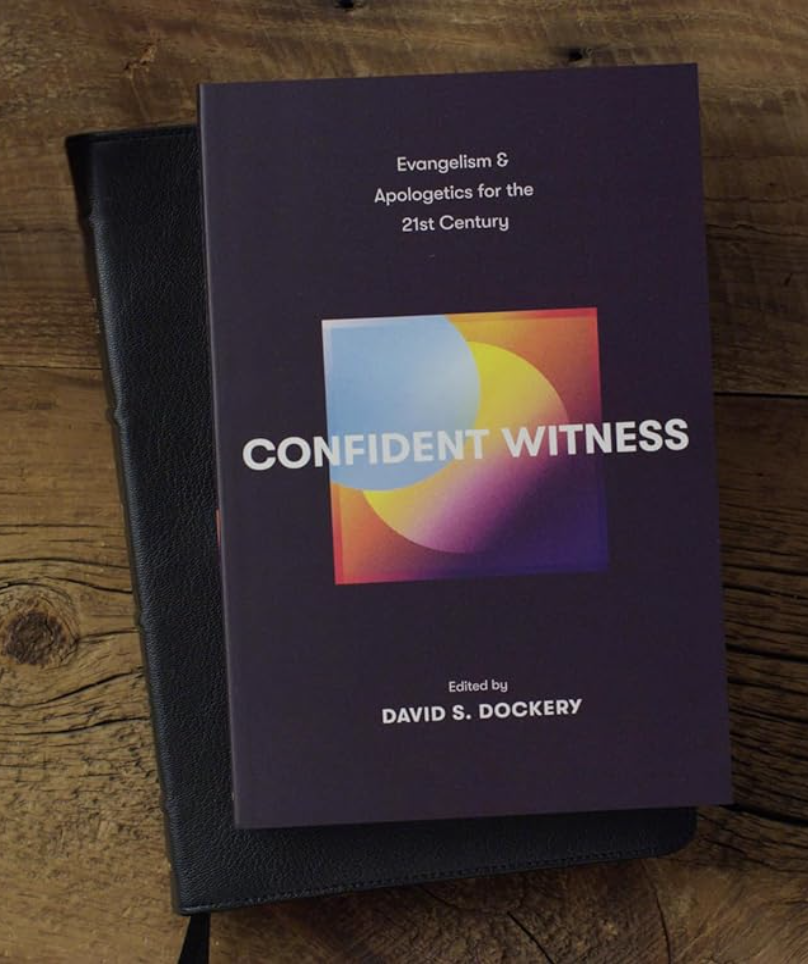
I’m a big fan of David Dockery for a number of reasons. He was the President of Union University when I was considering where to attend college and I was struck by his humble and thoughtful leadership when I visited campus. I didn’t go to Union, but I learned a lot about leadership in the way he led the Union community in the aftermath of the tornado of 2008. My first impression of him was such a blessing and I was struck by the way that he maintained a pastor’s heart while being wholeheartedly committed to Christian scholarship.
A few years ago, I read What Does it Mean to be a Thoughtful Christian? by Dr. Dockery and wanted to use it for our NCCS as our summer reading. I reached out to thank Dr. Dockery for writing such a helpful book and to ask if he knew where I could buy 50 copies in bulk for my teachers as a gift for the end of the school year. He replied quickly and asked for the address and gifted the books to us! I love his heart for Christian education and for building up fellow believers.
Most recently, I picked up Confident Witness, a collection of essays about Apologetics and Evangelism in the 21st century written by a variety of people and edited by Dr. Dockery. Several compelling thoughts to consider if we are going to stand strong in this culture and point to Jesus. I highlighted several things while reading and have posted those notes below…
- Evangelism therefore is a summons to lifelong obedience to the will of God in alignment with his purposes revealed through Jesus Christ, and it involves participation in God’s plans for heaven and earth and all their inhabitants. p. 18
- The Supremacy, Sufficiency, and Exclusivity of Christ For Jesus to solve our broken relationship with God, he had to be able to truly represent us as a human being and have the ability that God alone has to overcome sin and death. p. 54
- The essence of this message is that through faith in Jesus Christ, people can have a personal relationship with God and experience eternal life with him. To be precise, this message consists of six essential truths or key components necessary to proclaim the whole gospel. First, God is the perfect Creator of all the world, including human beings, made in his own image, and that God is worthy of praise for his creation (Rev. 4:11). Second, everyone has rebelled against God, and the Bible labels such rebellion “sin” (Rom. 3:10–12). Third, God is a great King who will not tolerate this ongoing revolt and will justly punish every sinful rebel for eternity (2 Thess. 1:8–9). Fourth, God is just, but also infinitely loving and merciful. For this reason, God sent his own Son, Jesus, to live as a man who never sinned in anything he ever thought, said, or did. Amazingly, Jesus voluntarily chose to die in the place of rebels so that God could legitimately punish sin while extending mercy to sinners (1 Pet. 3:18). Fifth, God raised Jesus from the dead to demonstrate in historical time and space that sins were forgiven, and a way has been opened to a right relationship with God (1 Pet. 1:3). Sixth, every person faces a choice either to live in obedience to God according to the perfect design of the original creation or to continue in rebellion and suffer the consequences of everlasting punishment (John 3:36). pp. 94-95
- The New Testament church found great motivation for evangelism both from gratitude for the wonders of salvation and from an appalling grief over the fate of lost people. Christians today would be more motivated toward evangelism if we better understood that there are only two options for the eternal state of every person we meet. p. 96
- Rational arguments are like candles, not floodlights. While they help illuminate the truth, they cannot dissipate all uncertainty. Even when evidence convinces us of Christianity, we need to trust Jesus; we must not only mentally acquiesce to his existence but must also pledge our allegiance (James 2:19). p. 111
- So how do we allow Spirit-led compassion to overwhelm our cultural divisiveness? We see, serve, befriend, pray for, fear and weep for, evangelize, and disciple our neighbors. p. 112
- See through the broken beliefs of others; we will stand naked of our opinions when we reach judgment day. p. 113
- J. I. Packer writes: “If you wish to do personal evangelism, then—and I hope you do; you ought to—pray for the gift of friendship. A genuine friendliness is in any case a prime mark of the man who is learning to love his neighbour as himself.” p. 115
- We are always one generation away from an awakening. The biblical call is still God’s invitation to us: “If my people who are called by my name humble themselves, and pray and seek my face and turn from their wicked ways, then I will hear from heaven and will forgive their sin and heal their land” (2 Chron. 7:14). We are not waiting on God; he is waiting on us. p. 121
- J.P. Moreland puts it bluntly: Our society has replaced heroes with celebrities, the quest for a well-informed character with the search for flat abs, substance and depth with image and personality. In the political process, the makeup man is more important than the speech writer, and we approach the voting booth, not on the basis of a well-developed philosophy of what the state should be, but with a heart full of images, emotions, and slogans all packed into thirty-second sound bites. p. 131
- Apologetics is defending the truth, goodness, and beauty of Christianity without assuming the unbeliever subscribes to biblical authority. p. 133
- Where Do We Go from Here? Christianity has been the most influential force in the history of global education. It has made more contributions to society and the world than any other movement or religion, by far and bar none. This is fundamentally due to the preeminence of Jesus Christ and his pedagogical perfection, which he modeled as the greatest teacher in history. Beyond that, the body of Christ, the church, has made a deep and positive impact on cultures, societies, and populations for the last two thousand years. Because the challenges being faced by the church and Christian education pose an existential threat to all we know, believe, and hold dear, this is no time to be passive. In the classic words of the late Wheaton professor Lois LeBar, “A revolutionary Gospel in a revolutionary age calls for revolutionary teaching that revolutionizes lives.” Just as Christian higher education has played a critical role in the past, Christian colleges, universities, seminaries, and divinity schools must also play a role now—and in the future. Here are ten recommendations on how professors and administrators can fight the good fight of the faith and aid the church in its work of evangelism and discipleship in the world:
- Demonstrate grace and truth. Show the kindness of God without compromising the word of God.
- Present apologetics and polemics. Apologetics defensively protects the faith from outside attacks, while polemics offensively disarms or negates false teachings from within or outside the church. Both are biblical.
- Build bridges and walls. Walls provide protection against danger and invasion, and form community to those who belong there; bridges provide smooth access and ease of connection. Both are biblical.
- Love God and love people. Loving God and loving people are not contradictory. There is always a way to do both if we understand the biblical meaning of “love.”
- Employ Word and Spirit. We must open our Bibles and also open our hearts. Avoid dead orthodoxy and conviction-free sentimentalism.
- Play offense and defense. Some Christian leaders live and serve in a perpetual state of defense. Others are always armed to the teeth. Our armor includes a sword and a shield.
- Use faith and reason. Augustine and, later, Anselm spoke about the importance of believing so one could gain understanding. Faith is important in Christian education, but so is the life of the mind.
- Stand alone and stand together. Develop the mettle to stand by yourself for Jesus and his truth, but value the need to stand with other believers.
- Be a disciple and make disciples.
- Live the gospel and share the gospel. It is not enough to live it; we must also tell it. The gospel should be shown, but it must also be proclaimed. p. 254