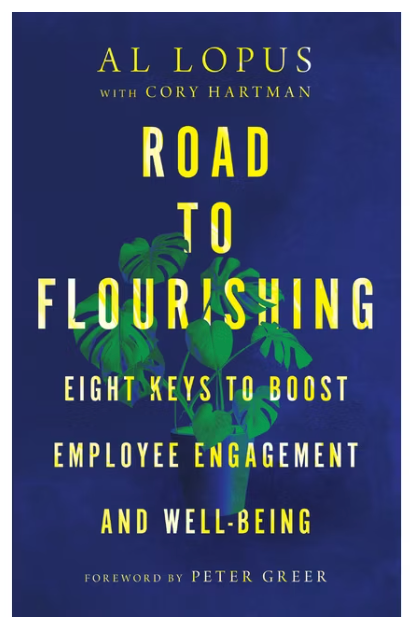
I’ve always heard a lot about Best Christian Workplaces as it relates to employee culture for evaluation and for celebration. Their philosophy is that “Kingdom impact hinges on the well-being of your people.” I couldn’t agree more! I’m thankful for the opportunity to learn more with a variety of their resources, but specifically through Road to Flourishing. This book gives an excellent framework for how to care for your people well so that they flourish in the work that God has called them to.
I highlighted several things while reading and have posted those notes below…
- Are you going to have an intentional culture or accidental culture? p. 1
- My encouragement is to avoid the temptations of denial or defense and instead commit to proactive listening and learning. You can’t fix what you don’t know is broken, and an accurate measure of your soil with empower you to lead with clarity. p. 3
- I became convinced that workplace culture determines employee engagement, and employee engagement determines organizational success. p. 7
- I have a dream of seeing Christian-led organizations set the standard as the best, most effective workplaces in the world. p. 12
- Employee engagement is a way of saying that team members are motivated to bring their fullest contribution, their unique giftedness and creativity, to their role in the organization for the sake of its success. p. 22
- Eight Keys to a FLOURISHING workplace culture
- Fantastic teams
- Life-giving work
- Outstanding talent
- Uplifting growth
- Rewarding compensation
- Inspirational leadership
- Sustainable strategy
- Healthy communication p. 24
- The first important step was to take small but swift actions that communicated to employees that they were heard and that things were changing, because the only thing worse than not listening to employees is to ask for their feedback and do nothing. p. 25
- Fantastic teams have several prominent features: communicate well, get things done, share credit for success, love being together, bring their whole selves to work, are inclusive and diverse, work through challenges with each other, and trust each other. p. 31
- Life-giving work is always tied to a clear, compelling organizational mission, but even more importantly, it always wraps around the employee’s mission. p. 52
- Purposeful work is life-giving work to everyone, but it is exceptionally important to younger workers. p. 55
- The truth that life-giving work isn’t all about work reveals one of the most important insights for Christian-led organizations: life-giving work embraces the whole person. p. 60
- A leader fosters life-giving work by keeping people close to the results. p. 63
- For millions of people of all religious backgrounds and no religion at all, the word vocation is virtually synonymous with occupation or career. Yet the root of the word occupation has to do with where you find yourself (like occupying a house), and career has to do with where you’re going (like being carried along). Vocation, however, like the word vocal, has to do with the voice that calls you. Luther and many other Christian thinkers realized that all Christians are called; we have all been summoned by God to serve him and serve others every day in the ordinary activities we do with extraordinary love. p. 64
- I define outstanding talent as highly qualified people with the necessary calling, character, competence, chemistry, and contribution to achieve the organization’s mission. p. 68
- The greatest asset you have (or lack), then, is a clear and compelling mission. Your mission is the first essential quality for recruiting outstanding talent, so make sure your candidates see it presented boldly and hear it loud and clear. Impact in a meaningful mission is the secret sauce that attracts outstanding talent; it is a leveler that enables nonprofits and churches to compete for talent with better resourced for-profit businesses. p. 71
- When Mike Treneer, former president of the Navigators, announced that he was retiring, people in the organization begged him not to. He replied, “We are all interim leaders.” He didn’t fall prey to the deception of his own importance. He demonstrated an open-handed attitude that recognizes that the organization or role isn’t one’s own-it is God’s-and that someday, someone different will occupy it and handle it differently from what we would do. A willingness to work hard as a steward for something one does not possess is essential to good character. p. 75
- Uplifting growth is the improvement of individuals, groups, and the whole organization to meet the challenges of a changing world. When employees learn new things, their elevated ability enables the organization to maintain and improve its effectiveness. But the organization also improves because employees are more engaged in what they do. p. 89
- When leaders take a moment to think about how they learned to do what they do, they almost always find that it came in situations where they were in over their heads. The irony is that many leaders try very hard to keep their subordinates from those very situations. p. 95
- A compensation approach that communicates fairness and respect involves four elements: external equity, internal equity, seniority, and merit. p. 112
- Giselle used to tell Prison Fellowship’s leaders, “I would like to have our compensation plan be so equitable that if I accidentally left it out on a desk and people saw it, that there would be no surprises and no hypocrisy.” p. 114
- Inspirational leadership is not just one key among many; it is the key that turns the other keys. p. 129
- There are many positive character qualities in leaders that correlate with a flourishing workplace culture, but we can narrow them down to three: trustworthiness, care, and selflessness. p. 132
- By analyzing organizations with a flourishing workplace culture – especially those that have gone through a turnaround – The Best Christian Workplaces Institute has identified six disciplines that appear over and over in the lives of inspirational leaders.
- Inspirational leaders pursue the truth.
- Inspirational leaders embrace the truth.
- Inspirational leaders listen to their people.
- Inspirational leaders act on what they hear.
- Inspirational leaders establish core values.
- Inspirational leaders invest in the leaders around them. p. 140